16 Home Electronics You’ll Wish You Had Bought Sooner
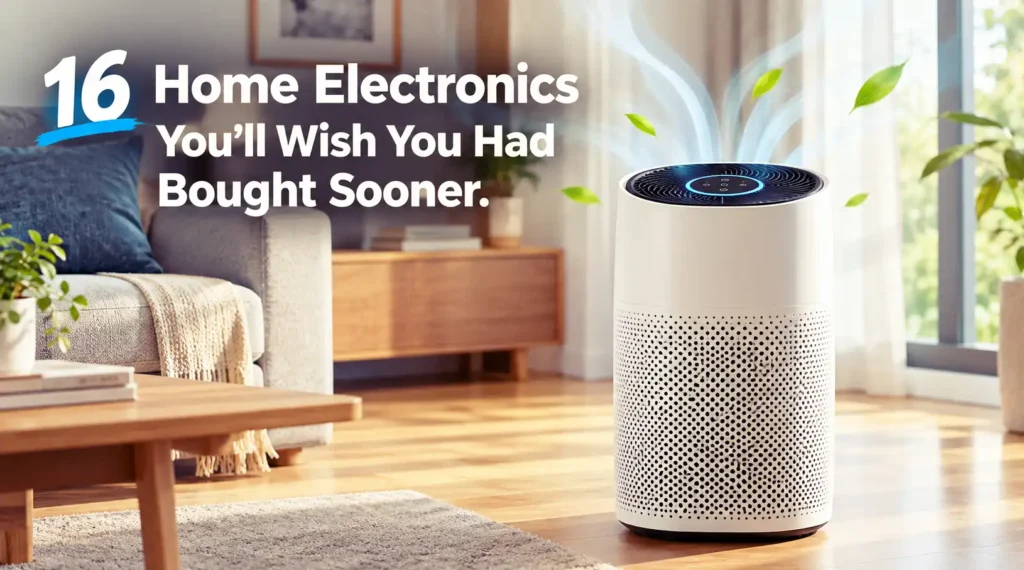
Home electronics illustration featuring a modern air purifier in a stylish living room.
Have you ever bought something for your home and wondered how you managed without it for so long? That is exactly what happens when you discover the right home electronics. From smart devices that automate everyday tasks to entertainment gadgets that make relaxing at home more enjoyable, the right technology can make a surprisingly big difference in your daily routine.
Modern home electronics are no longer just about having the latest gadgets or showing off a fancy living room. They are about convenience, comfort, efficiency, and getting more out of the space you already have. A smart plug can help automate an ordinary lamp, a robot vacuum can reduce the time you spend cleaning, and a streaming device can breathe new life into an older television. Sometimes, even an affordable gadget can solve a problem that has annoyed you for years.
The best part is that you do not need to turn your house into a futuristic smart home to enjoy these benefits. Many useful devices work independently, require minimal setup, and fit comfortably into a modest budget. You can start with one gadget that solves a specific problem and gradually add more as your needs change. The trick is knowing which products offer genuine everyday value and which ones are likely to collect dust in a drawer.
In this guide, we will explore 16 home electronics that can make everyday life easier, more comfortable, and more enjoyable. From practical kitchen appliances to smart home accessories and entertainment devices, these picks cover different rooms, lifestyles, and budgets. Whether you live in a small apartment or a spacious family home, you might discover a few gadgets that make you think, Why didn’t I buy this sooner?
What Are Home Electronics?
Home electronics are electronic devices designed to improve the way you live, work, relax, and manage everyday activities at home. They include everything from televisions, wireless speakers, and streaming devices to smart lighting, security cameras, air purifiers, and automated cleaning gadgets. Some focus on entertainment, while others help you save time, monitor your surroundings, or make your living space more comfortable.
Unlike traditional household equipment that mainly performs mechanical tasks, many modern home electronics offer digital controls, wireless connectivity, automation, or integration with mobile apps. However, a device does not need Wi-Fi, artificial intelligence, or voice control to be useful. Sometimes, a simple electronic appliance that performs one job exceptionally well is more valuable than an expensive gadget packed with features you will rarely use.
Why Are These Home Electronics Worth Buying?
The biggest reason to invest in useful home electronics is that they can eliminate small frustrations that add up over time. Imagine no longer having to manually switch off a lamp across the room, spend as much time vacuuming the floor, or struggle to hear dialogue clearly during a movie. Each improvement might seem minor on its own, but together, these conveniences can make your daily routine noticeably smoother.
There is also the potential for better energy management, improved indoor comfort, and more flexible entertainment options. Smart controls can help you manage certain devices more efficiently, while air-quality monitors and security cameras can provide useful information about your home. Of course, not every product guarantees lower bills or better performance, so it is worth considering its actual benefits, operating costs, compatibility, and reliability before spending your money.
16 Best Home Electronics to Make Everyday Life Easier
The best home electronics are not necessarily the most expensive or complicated ones. They are the devices that solve everyday problems, save you time, or make your home more enjoyable without adding unnecessary hassle. From practical cleaning tools to smart entertainment upgrades, the following gadgets are worth considering if you want to make your living space more comfortable and convenient.
Before buying anything, think about your actual needs, available space, and budget. Some devices deliver the most value when used daily, while others are useful only in specific situations. Here are 16 home electronics that deserve a place on your shopping list, along with the reasons they might become some of your favorite household purchases.
1. Robot Vacuum Cleaner
A robot vacuum cleaner is one of those gadgets that can make you question why you spent so many years vacuuming manually. It moves around your floors automatically, collecting dust, crumbs, pet hair, and other everyday debris while you focus on something else. Many modern models support scheduling through a mobile app, allowing you to set cleaning sessions while you are working, relaxing, or away from home.
Some models also include mopping functions, room mapping, obstacle detection, and automatic dirt disposal. You do not necessarily need all these extras, though. If you live in a small home with mostly hard floors, an affordable robot vacuum may already be useful. Just remember that it will not completely replace manual cleaning, especially around stairs, tight corners, tangled cables, or heavily cluttered areas.
2. Smart Plug
A smart plug is a small but surprisingly useful device that lets you control compatible electrical appliances through a smartphone app or, depending on the model, a voice assistant. Plug a table lamp, fan, or another suitable appliance into it, and you can switch the power on or off remotely. Many smart plugs also support schedules, making it possible to automate everyday routines without replacing your existing appliances.
For example, you could schedule a lamp to turn on before sunset or automatically switch off a desk light at bedtime. Some models include energy-monitoring features that help you track electricity consumption. Before buying one, check its maximum power rating, Wi-Fi requirements, and compatibility with your appliances. Avoid using a smart plug with equipment that draws more power than the device is rated to handle, and remember that cutting power is not the same as properly shutting down every electronic device.
3. Smart LED Bulbs
Smart LED bulbs offer a simple way to change the atmosphere of a room without installing complicated lighting systems. Depending on the model, you can adjust brightness, switch between warm and cool white light, or choose different colors through an app. You can also create schedules, group several bulbs together, and coordinate your lighting with your daily activities.
These bulbs are especially useful in bedrooms, living rooms, and home offices, where lighting needs change throughout the day. Warm light can create a relaxing atmosphere in the evening, while brighter, cooler settings may be preferable when working or reading. Some bulbs connect directly to Wi-Fi, while others require a dedicated hub. Check the bulb base, brightness, connectivity, and dimmer compatibility before purchasing one.
4. Air Purifier
An air purifier can be a worthwhile addition to your home if you regularly deal with dust, airborne particles, pet dander, or certain seasonal allergens. Models equipped with properly rated HEPA filters can capture many airborne particles as air passes through the filtration system. This can be particularly useful in bedrooms, living rooms, and other spaces where you spend a significant amount of time.
However, choosing the right purifier matters more than simply buying the most expensive model. Check its clean air delivery rate (CADR), recommended room size, noise level, and replacement-filter costs. A purifier also needs regular maintenance to work effectively. Avoid models that intentionally generate ozone, and remember that air purifiers do not eliminate every indoor pollutant or replace good ventilation and regular cleaning.
5. Smart TV Streaming Device
A smart TV streaming device is an excellent way to upgrade your entertainment setup without buying an entirely new television. These compact gadgets connect to your TV through an HDMI port and give you access to streaming platforms, online videos, music services, and other apps. Depending on the device, you may also get voice search, personalized recommendations, screen casting, and a smoother interface than the one built into an older television.
This gadget is especially worthwhile if your current TV still delivers good picture quality but has become slow or no longer supports certain apps. Before buying one, check whether it supports your preferred streaming services, the resolution of your TV, and your available Wi-Fi connection. Some devices support 4K and HDR, but those features will only benefit you if your television and content support them too. Also, compare the available operating systems because the interface and app selection can vary considerably.
6. Wireless Bluetooth Speaker
A wireless Bluetooth speaker makes it easy to enjoy music, podcasts, audiobooks, and other audio content in almost any room. Instead of relying on your phone’s small built-in speakers, you can connect your phone, tablet, or laptop and enjoy fuller sound. Portable models are particularly convenient because you can move them between your bedroom, kitchen, living room, or outdoor seating area without dealing with cables.
When shopping for one, pay attention to sound quality, battery life, Bluetooth range, and durability rather than focusing only on maximum volume. Water resistance is a useful feature if you plan to use the speaker near a kitchen sink or outdoors, although it does not make every model suitable for submersion. If you mainly listen to music at home, a larger speaker with better bass may be preferable. For people who value portability, a compact model can be the better everyday companion.
7. Video Doorbell
A video doorbell lets you see who is standing outside your front door without having to walk over and look through a window. Depending on the model, it can send motion alerts to your phone, provide two-way audio, and record video clips when someone approaches. This is especially convenient when you are busy cooking, working in another room, or waiting for a package to arrive.
Before purchasing one, check its power requirements, Wi-Fi signal strength at your entrance, night-vision performance, and video storage options. Some models use rechargeable batteries, while others require existing doorbell wiring. You should also check whether essential features require a monthly subscription. For privacy, position the camera to focus on your entrance rather than unnecessarily recording neighbors or public areas, and secure your account with a strong, unique password.
8. Smart Thermometer and Hygrometer
A smart thermometer and hygrometer measures indoor temperature and humidity, helping you understand the conditions inside your home. Many models display readings on a small screen and send data to a smartphone app. Some also provide alerts when humidity or temperature moves outside your preferred range, making it easier to spot uncomfortable conditions before they become a bigger annoyance.
This device can be particularly useful in bedrooms, storage areas, and rooms where dampness is a recurring concern. High indoor humidity can encourage mold growth under suitable conditions, while excessively dry air may cause discomfort for some people. With reliable measurements, you can make more informed decisions about ventilation, dehumidification, or humidification. Just remember that a basic sensor does not control the environment itself; it tells you what is happening so you can respond appropriately.
You can make your household appliances more convenient to control with 7 Smart Plugs to Make Your Home Electronics Smarter, which explores practical ways to automate everyday devices and simplify your home routine.
9. Smart Security Camera
A smart security camera gives you a convenient way to check what’s happening around your home, even when you’re away. Depending on the model, you can watch live footage from your phone, receive motion notifications, and review recorded clips when something unusual happens. Indoor cameras can help you monitor entryways or shared spaces, while outdoor models are designed to withstand weather and provide visibility around entrances, garages, or gardens.
When choosing a security camera, look beyond the advertised resolution. Night vision, motion detection accuracy, storage options, and Wi-Fi reliability can make a bigger difference in everyday use. Some cameras store footage locally on a memory card, while others rely on cloud subscriptions. Check these costs before buying, and secure the camera with a strong password and available security updates. If you install one indoors, be mindful of privacy, especially in bedrooms and other sensitive spaces.
10. Electric Kettle
An electric kettle is one of the simplest home electronics you can buy, yet it can become an essential part of your daily routine. With the press of a button, you can heat water for tea, coffee, instant noodles, oatmeal, or other quick meals. Compared with heating water on a stovetop, an electric kettle can be more convenient because it requires less supervision and many models automatically switch off when the water boils.
Some kettles offer adjustable temperature settings, which are particularly useful if you enjoy different types of tea or prepare coffee that benefits from water below boiling temperature. Others include insulated designs that help keep water warm for longer. For most households, capacity, ease of cleaning, and automatic shutoff are more important than fancy extras. Choose a model with a suitable power rating for your electrical supply, and avoid operating it without enough water.
11. Microwave Oven
A microwave oven can save a surprising amount of time when preparing meals, reheating leftovers, or defrosting frozen ingredients. Instead of dirtying a pan just to warm yesterday’s dinner, you can place your food in a microwave-safe container and have it ready within minutes. It’s especially useful for busy households, students, and anyone who wants convenient meals without spending too much time in the kitchen.
Depending on your cooking habits, you might prefer a basic microwave or a more versatile model with grill and convection functions. A larger capacity can accommodate bigger dishes, but it also takes up more counter space. Look at the wattage, internal dimensions, available power levels, and cleaning requirements before making a decision. For more even heating, stir food when appropriate and allow it to stand briefly after heating, since some areas may become hotter than others.
12. Air Fryer
An air fryer uses rapidly circulating hot air to cook food and create a crisp exterior with relatively little added oil. It’s a handy option for preparing fries, chicken pieces, roasted vegetables, and reheated leftovers without heating a full-sized oven. For smaller portions, it can also be quicker and more convenient than conventional oven cooking, making it a practical appliance for everyday meals.
The right capacity depends on how many people you usually cook for. A compact model may be enough for one or two people, while a larger basket can make family-sized portions easier to prepare. Check the available cooking programs, temperature range, basket design, and ease of cleaning before buying. Keep in mind that an air fryer is not automatically healthier for every food, and cooking results still depend on the ingredients and preparation method. Avoid overcrowding the basket if you want food to cook evenly and develop a crisp texture.
13. Water Flosser
A water flosser is a useful addition to your bathroom routine if traditional dental floss feels uncomfortable or difficult to use consistently. It directs a controlled stream of water between your teeth and along the gumline to help remove food debris and plaque. Many models offer adjustable pressure settings, making it easier to find a comfortable setting for everyday use. Some also include different tips for specific cleaning needs.
This device can be especially convenient for people with braces, dental bridges, or other dental work that makes cleaning between teeth more challenging. However, a water flosser should complement rather than automatically replace brushing and other recommended oral hygiene practices. When choosing one, consider water-tank capacity, battery life, pressure settings, and replacement-tip availability. If you have sensitive gums or a particular dental condition, ask your dentist how to use it appropriately.
14. Dehumidifier
If your home frequently feels damp, a dehumidifier could make a noticeable difference in everyday comfort. It removes excess moisture from indoor air, helping create conditions that are less favorable for mold growth and musty odors. This can be particularly helpful in bathrooms, laundry areas, bedrooms, and other spaces where humidity tends to build up. Some models also include humidity sensors and automatic settings that regulate operation according to the room’s conditions.
When shopping for a dehumidifier, consider its moisture-removal capacity, recommended room size, noise level, and electricity consumption. A model with continuous drainage can be convenient if you don’t want to empty the water tank regularly, provided your room has a suitable drainage arrangement. Keep in mind that a dehumidifier cannot fix the underlying cause of persistent dampness, such as a leaking pipe or water entering through a wall. Addressing those problems is essential for a lasting solution.
15. UPS (Uninterruptible Power Supply)
An uninterruptible power supply, commonly known as a UPS, provides temporary battery power when the electricity goes out. It’s particularly useful for desktop computers, home networking equipment, and other electronics that could be disrupted by a sudden loss of power. Depending on its design, a UPS may also help protect connected equipment from certain electrical disturbances, giving you time to save your work or shut down devices properly.
A UPS is worth considering if you frequently experience power interruptions or depend on your computer for work, study, or important projects. Pay attention to its wattage capacity, battery runtime, outlet configuration, and replacement-battery availability. A higher VA rating alone does not guarantee longer backup time, because runtime also depends on the connected load and battery capacity. For a desktop PC, choose a model that can support the actual power consumption of your setup, and remember that a UPS is a temporary backup rather than a substitute for a reliable electricity supply.
16. Universal Remote Control
A universal remote control can simplify your entertainment setup by allowing you to operate multiple compatible devices with one controller. Instead of reaching for separate remotes for your television, soundbar, and streaming equipment, you can potentially manage several functions from a single device. Some models use infrared signals, while others support Bluetooth, Wi-Fi, or a combination of connection methods, depending on the equipment they’re designed to control.
This gadget is especially useful if your coffee table has become a storage spot for a small collection of confusing remotes. Before buying one, confirm that it supports your specific devices and the functions you actually use. Basic infrared remotes may work well with older televisions and audio equipment, while newer streaming devices sometimes require Bluetooth or dedicated controls. If your television already supports HDMI-CEC, enabling that feature may also let you control certain connected devices using your existing TV remote without purchasing anything extra.
Conclusion
The best home electronics are the ones that make your everyday life easier without creating unnecessary expenses or complications. From robot vacuum cleaners and smart plugs to air fryers and UPS devices, each gadget on this list offers a practical benefit that can improve how you manage your home. You don’t need to purchase all 16 products at once, either. Start with the devices that solve your biggest daily frustrations, then consider other upgrades when your budget allows.
Before making a purchase, think about how often you’ll use the device, how much space it requires, and whether its ongoing costs are reasonable. Features such as Wi-Fi connectivity, automation, and app controls can be useful, but they aren’t always essential. Sometimes, a simple, reliable product provides better long-term value than a more expensive model packed with features you’ll rarely touch.
Ultimately, the right home electronics should work for you rather than give you more things to manage. Whether you want to save time cleaning, improve your entertainment setup, prepare meals more conveniently, or protect your computer during power interruptions, there’s probably a gadget that fits your needs. Choose wisely, and you might soon find yourself wondering how you ever managed without it.
FAQs
1. What Are the Most Useful Home Electronics to Buy First?
The most useful home electronics depend on your daily routine and priorities. A smart plug can be an affordable starting point for automating compatible appliances, while an electric kettle, microwave oven, or air fryer can make food preparation more convenient. If cleaning takes up too much of your time, a robot vacuum might be a better investment. Focus on the problems you want to solve instead of buying gadgets simply because they’re popular.
2. Are Smart Home Devices Worth the Money?
Smart home devices can be worth the investment if their features provide genuine convenience or help you manage your home more effectively. Smart bulbs, plugs, and security cameras can simplify everyday tasks, but their value depends on how frequently you use them. Before buying, check compatibility, electricity consumption, subscription fees, and whether the device requires an internet connection to function properly.
3. Which Home Electronics Can Help Reduce Electricity Costs?
Devices such as energy-monitoring smart plugs, efficient LED bulbs, and appropriately sized appliances can help you understand or manage electricity consumption. However, savings are not guaranteed and depend on how you use them. A smart plug can reveal the power consumption of compatible equipment, while LED bulbs generally use less electricity than traditional incandescent bulbs for similar light output. Compare actual energy ratings and operating habits before expecting lower bills.
4. What Should I Consider Before Buying Home Electronics?
Consider your budget, available space, intended use, power requirements, and the product’s long-term maintenance costs. For connected devices, check Wi-Fi compatibility, app support, privacy protections, and whether essential features require a subscription. It’s also worth researching warranty coverage and replacement-part availability. A product that fits your needs and remains easy to maintain is often a better choice than one with the longest feature list.
5. Do I Need Smart Home Electronics to Make My Home More Convenient?
No, you can make your home more convenient without building a smart home system. Appliances such as electric kettles, microwave ovens, air fryers, and UPS devices provide practical benefits without requiring complicated setup or internet connectivity. Smart devices are useful when automation or remote control solves a specific problem, but traditional electronic appliances can be just as valuable for everyday living.