9 Crazy-Cool Gadgets You’ll Want to Own in 2026
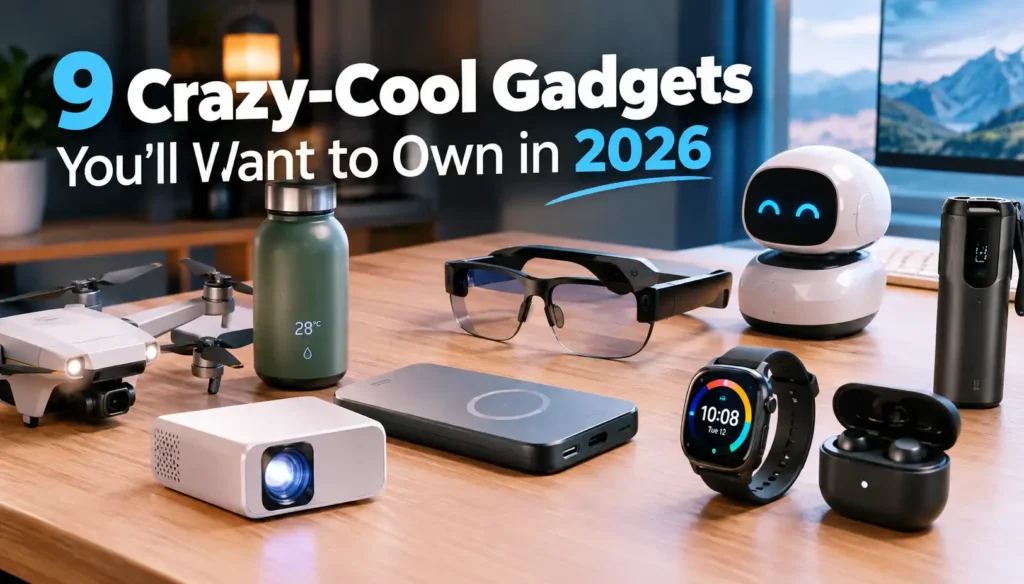
An illustration showcasing nine cool gadgets you’ll want to own in 2026.
From smart glasses that put info right in your line of sight to tiny AI gadgets that take care of genuinely useful little jobs, there’s no shortage of tech that feels straight out of a sci-fi movie. And the best part? These ideas aren’t just pricey prototypes anymore—they’re finally becoming practical for regular people.
But just because something looks “crazy cool” doesn’t mean it’s actually worth having. A lot of gadgets seem exciting at first, but end up collecting dust in a drawer. Others, though, might seriously change how you get things done, unwind, or run your home. Choosing the right one is a lot more interesting than just picking whatever ad catches your eye.
So, what gadgets should you actually keep an eye on in 2026? We’ve found nine categories with a good mix of fun, futuristic designs, and genuine usefulness. Whether you’re a hardcore tech fan or you just like keeping up with what’s new, there’s bound to be at least one here that makes you think, “Okay, I need that.”
Why These 2026 Gadgets Stand Out
By 2026, gadgets aren’t about just cramming in random features anymore. Instead, they’re focused on making tech feel natural. More devices have built-in AI, wireless stuff just works better, and smaller hardware doesn’t always mean it’s weaker. Gear that used to require a whole stack—phone, laptop, a bunch of extras—can now often do it all on its own.
There’s also a big shift toward gadgets that actually fit into your life and routines, not ones that force you to work differently. Whether it’s a wearable that quietly tracks data without demanding attention, something that puts your games in your backpack, or a smart device that handles dull chores at home, the coolest gadgets solve real problems while still feeling just a little futuristic.
9 Crazy-Cool Gadgets to Check Out in 2026
What follows is a pretty wild mix—wearables, gaming gear, smart home stuff, and portable entertainment. Not all of them are for everyone, and let’s be real: you don’t need all nine. Just think of this as a tour of the most exciting trends, full of gadgets that offer something actually useful and still give you that “I want one” itch.
1. AI-Powered Smart Glasses
Smart glasses are finally moving past just putting a small screen in front of your eyes. The most interesting versions in 2026 focus on AI assistants, plus features like cameras, mics, speakers, and hands-free controls. So you don’t have to pull out your phone every time—you use your voice to ask questions, snap photos, get info about what you’re looking at, or listen to messages, all without tying up your hands. The point isn’t to replace your phone, just to make some everyday things even easier.
The real draw? Convenience. You could wander through a new city and chat with your AI assistant without ever staring at a screen or record a funny moment in a snap. Obviously, privacy, battery life, comfort, and just not looking weird still matter. Nobody wants to feel like they’ve got a computer stuck to their face. But if companies can make smart glasses stylish and comfy, this could be the must-have wearable of 2026.
Why Even Bother With Smart Glasses?
It really comes down to AI and hands-free everything. Glasses that can see and hear what you do, but let you keep your eyes on what’s happening around you, feel nothing like tapping at a phone.
Who Will Like Them?
Smart glasses are perfect for people who love trying the latest tech, travel a lot, make content, or just prefer hands-free ways to get digital help. If you’re just after a regular pair of glasses without any extra features, you can skip these.
2. Next-Generation Smart Rings
At first, smart rings seem almost too simple, but just wait until you see what they pull off. Unlike smartwatches, rings don’t need a big screen, so they stay small and comfortable. Depending on the brand, they can track your steps, sleep, heart rate, and more—all quietly sending that info to your phone for you to look at later.
What’s cool in 2026 is how easy it is to wear one all the time. Sleep, work, workouts, or just everyday running around—they’re always gathering data without demanding attention. They’re basically secret little sensors in the shape of a ring. The downside is you don’t get alerts or phone features like with a smartwatch; it’s much more about passive tracking than being interactive.
More Than a Simple Accessory
A smart ring looks like a basic piece of jewelry, but it’s actually full of tiny sensors inside. The best thing about a smart ring is how quietly it collects data—there’s almost nothing else you need to do.
Fitness, Health, and Everyday Life
If you’re curious about how you sleep or want a low-key way to track your activity, smart rings are a clever option. They’re especially good if you care about stats but don’t want to wear a screen on your wrist.
3. Portable Gaming Handhelds
Handheld gaming consoles have shifted from niche toys to real gaming powerhouses. Nowadays, these things run demanding PC games, connect to online libraries, and feel closer to a compact gaming PC than anything we had a few years back. The tech inside—faster chips, better screens, improved cooling—means your favorite games follow you anywhere.
Their biggest perk? Flexibility. You can play on the couch, in bed, or on a road trip without missing out on the latest titles. Some even double as mini computers for other stuff. Sure, issues like battery life, heat, or chunky controls haven’t disappeared, but for anyone who’s ever wanted to take their whole gaming setup on the go, today’s handhelds deliver.
PC-Level Gaming in Your Hands
Packing this kind of performance into something this small is seriously cool. Games that used to need a full desktop now run on a handheld—though you might have to turn down the graphics a bit.
Why Handheld Gaming Keeps Growing
Convenience is the obvious answer. Gamers don’t always want to sit at a desk for hours, and handhelds let them continue playing without being tied to one location. For many people, that flexibility can be just as valuable as raw performance.
4. Smart Home Security Gadgets
Home security is getting a big upgrade now that cameras, sensors, and doorbells work together and use smarter detection. Instead of just showing you a video of everything, the newest gear knows what kind of activity matters and only sends an alert when you need to pay attention. Pretty handy—not just another notification when a stray leaf blows by.
These systems connect, too. A motion sensor might turn on a camera or flip a light on, setting up a more responsive home. The key is still privacy, good Wi-Fi, and having ways to safely store your footage. You want to feel safe, not worried about who else could be watching your front porch.
Cameras and Sensors That Know the Difference
New AI-powered cameras catch what matters and ignore what doesn’t. Paired with other sensors, you get a much clearer picture of what’s really happening at home.
Smarter Notifications, Better Automation
The magic comes when gadgets work together on their own. Maybe the lights come on when there’s movement, or you get a heads-up for something new. Devices that actually talk to each other just make more sense.
If you enjoy horror games that build tension without relying on cheap jumpscares, check out 6 Horror Games That Are Somehow Scarier Without Jumpscares.
5. Pocket-Sized AI Gadgets
AI isn’t stuck in your phone or laptop anymore. One of the cooler trends in 2026 is tiny, specific AI gadgets built to handle certain jobs without needing a full-blown app. Tap a button or talk, and gadgets like these can record a conversation, sum up info, answer a question, translate something, or help organize your to-do list—all from your pocket.
Here, the interaction’s the fun part. No fumbling through apps or typing; these little devices just do their thing, fast. Of course, you have to wonder if you really want another thing to charge and carry when your smartphone already does most of it. For some people, the hassle’s worth it if the device is faster, more direct, or just easier. For others, it might just be an expensive way to duplicate tools your phone already has.
Small Size, Surprising Power
There’s a lot crammed into these tiny gadgets—microphones, processors, wireless connections, and smart software. Their size lets you handle quick tasks without ever pulling out your phone.
Are These AI Gadgets Really Worth It?
If one of these does a job faster than your phone, it earns its keep. If it just repeats what you already have—but adds a battery to remember to charge—it’s a tougher sell.
6. Modular and Repairable Gadgets
Modular gadgets are a breath of fresh air for anyone sick of tossing an entire device when one thing breaks. Now, some hardware lets you swap out, fix, or update parts like batteries or storage. This works with phones, laptops, keyboards, and more. A replaceable battery might not be glamorous, but two or three years down the line, it makes life easier.
There’s something nice about owning tech you can actually fix. If one part goes, you don’t have to junk the whole thing, and it helps cut down on waste. Of course, making stuff easy to repair often means gadgets will be a little bulkier or cost more, but for a lot of people, that’s a fair trade.
Why You Might Want Upgradeable Hardware
Upgrading single parts can make your favorite gadgets last years longer. Instead of buying a brand-new device every time something fails, you swap out whatever’s busted.
Save Money, Keep Your Stuff
Fixable devices might be a little investment up front, but over time, you save cash—especially when batteries or keyboards give out. It’s just nice knowing you don’t have to toss the whole thing when something small breaks.
7. Next-Level Wireless Audio Gadgets
Wireless audio’s come a long way from just ditching the cord on your headphones. These days, modern earbuds and headphones pack in active noise cancellation, spatial audio, sharper mics, multipoint connectivity, adaptive sound, and a bunch of AI-powered tricks. Some sets can change how much of the outside world you hear on the fly, while others make bouncing between your phone, laptop, and whatever else feel seamless.
What’s actually exciting here isn’t just the tech — it’s how audio is adjusting to wherever you are. Maybe you want full-on noise cancellation for a flight, a transparency mode while you’re out walking, or you need to sound extra clear during a video call. Battery life and comfort haven’t stopped mattering, though. Because if you’ve got the coolest earbuds on the market but your ears ache after 30 minutes or you run out of juice halfway home, well, that’s just annoying.
Beyond Traditional Earbuds
There’s a whole bunch of new wireless audio gear experimenting with design and purpose — think open-ear headphones, smarter buds, and devices that aim to keep you aware of your surroundings. The point isn’t to shut out the world entirely; sometimes, you want to hear what’s going on while you’re listening to your own thing.
Features That Actually Matter
When you’re picking out wireless audio gear, stuff like battery life, mic quality, comfort, a solid connection, and good noise cancellation are what really count. All those flashy features are fine, but honestly, you just want something that makes listening better — not a gadget that feels like a hassle every time you leave the house.
8. Portable Projectors and Mini Displays
Portable projectors are another fun category. They can take any space — literally, your living room, backyard, or an Airbnb — and turn it into a movie theater. These little projectors can fit in a bag, but throw a decently big image up on a wall or screen. Handy for movie nights, gaming, presentations, or just watching a show somewhere a TV isn’t an option.
The best part is flexibility. You don’t need a dedicated room or to mount a huge screen somewhere. When you’re done, just put the projector away. Some projectors even have built-in speakers, smart OS, auto-focus, and image correction, so you don’t have to fuss to get a good picture. Still, if you’re using it during the day, brightness matters. A projector that’s perfect in a dark room might look washed out in bright daylight.
Turning Any Room Into a Theater
With a compact projector, even a boring blank wall becomes your big screen in minutes. It’s a different vibe — more of an “event” than just flicking on the TV.
What to Look for Before Buying
Check the brightness, resolution, how far it needs to be from the wall (“throw distance”), auto-focus, connections, and speaker quality. Portability is nice, but a tiny, ultra-light projector isn’t worth much if you can’t see the picture unless the room’s pitch-black.
9. Smart Charging and Power Gadgets
Charging gear never sounds as flashy as smart glasses or portable game consoles, but honestly, they’re some of the most practical tech you’ll own. Now, you’ve got charging stations, multi-port GaN chargers, magnetic stuff, and power banks that keep your desk or nightstand a lot less cluttered. Some charge a bunch of devices at once and barely take up any space.
The real win here is convenience. Picture one small charger taking care of your phone, earbuds, watch, tablet, laptop — it’s so much easier than having a different block and cable for everything. New power banks give more juice for power-hungry devices, and that’s a lifesaver when you’re traveling or just far from an outlet all day. But, don’t forget to check things like charging standards, how much power it puts out, cable quality, and device compatibility before you buy. “Fast charging” doesn’t mean every single gadget will juice up instantly.
Smarter Power Banks and Charging Stations
Now, chargers are made for several devices in mind. With a clever charging station, you can turn one outlet into a central hub. A good power bank keeps all your stuff going on trips or on long days out.
Why Better Charging Gear Makes a Difference
A good charging setup keeps your gadgets ready, saves time, and seriously cuts down on cable mess. It’s one of those little quality-of-life fixes you might not notice at first, but once you’re charging everything from the same spot, going back to tangled adapters feels pretty brutal.
How to Choose the Right Crazy-Cool Gadget
With so many futuristic gadgets begging for your attention, it’s easy to get dazzled by cool demos and a long list of features. Before you buy, think about what you actually want to solve. Are you going to use it a couple of times a week, or just once and toss it in a drawer? A really useful gadget should help your routine, not add another chore to your life.
Don’t forget the boring stuff manufacturers skip over: battery life, whether the software is any good, if it works with what you have, if it’s repairable, if you need subscriptions, or if it’ll last more than a year. Sometimes, a gadget can sound amazing on paper but turn into a pain if the companion app is buggy or the best features are behind another paywall. So, don’t just ask, “Is this cool?” Ask, “Is this actually cool for me?”
Think About How You’ll Actually Use It
Try picturing a regular week with the gadget, not just the first 15 minutes out of the box. If you can instantly think of three or four times when it’ll save you time, be easier, or make something more fun, that’s a sign it’s worth it.
Check Compatibility Before Buying
Always see if the gadget plays nice with your phone, OS, smart-home stuff, accessories, and how you charge. A fantastic-looking device isn’t so great if it becomes a very expensive paperweight.
Don’t Pay Extra for Gimmicks
Not every futuristic thing is worth the splurge. AI, sensors, flashy screens, and voice control are neat — when they solve problems. Sometimes a simpler gadget with fewer features is the one you’ll actually want to keep using in six months.
Are Crazy-Cool Gadgets Really Worth Buying in 2026?
It all comes down to what you want. A futuristic gadget can be genuinely useful if it solves a problem you actually have, saves you time, or makes stuff you already love more fun or easy. Smart glasses, portable game consoles, wireless audio, projectors, advanced chargers — they all have their place, but not every model deserves your cash.
The safe bet? Look past the hype and ask how it fits into your stuff. Check battery life, compatibility, whether the software holds up, if you can get it fixed, what it’s like for privacy, and whether the features you care about are behind a subscription. Gadgets don’t have to be mind-blowing to be worth it. Sometimes, the best upgrade is just something small that fixes a daily annoyance.
Conclusion
2026 looks awesome for gadget fans — everything’s getting smaller, smarter, and way more woven into daily life. Wearables powered by AI, mini gaming systems, smart-home gear, modular gadgets, advanced earbuds, portable screens, better charging solutions — it’s all proof that tech makers are thinking in new directions to make life easier.
But don’t feel like you have to buy every flashy thing you see. The best gadget’s the one you’ll actually use. Before you drop any cash, think about your daily routine, what you already own, and the problem you want solved. If a gadget fits into your life naturally, that’s when the tech actually matters — that’s when it stops being a gimmick and turns into something you rely on.
FAQs
1. What are the coolest gadgets to buy in 2026?
Some of the stand-out categories include AI-powered smart glasses, smart rings, portable game consoles, AI-enabled home security, dedicated AI gadgets, modular hardware, next-gen wireless audio, portable projectors, and upgraded chargers. The right pick comes down to what you’ll actually use, and how it fits into your routines.
2. Are AI gadgets worth buying in 2026?
AI gadgets earn their keep when they speed up a task or make it easier — things like note-taking, summarizing, answering questions, translating, or hands-free help. But be careful: some just repeat stuff your phone can already do. So always check if those features are really new for you.
3. What gadgets are useful for everyday life?
In day-to-day life, gear like smart chargers, wireless earbuds, home sensors, security cameras, smart rings, and portable power banks do the trick. They’re at their best when they remove an annoying headache, not when they just show off one more random feature.
4. Which gadgets make good gifts in 2026?
Portable game consoles, wireless audio gear, smart rings, mini projectors, or solid charging stations all make for fun tech gifts. But the best gift really depends on what the person already uses and likes — compatibility can make or break it.
5. How do I avoid buying a gadget that becomes useless quickly?
Skip the launch hype and look for products with solid software support, features that really matter, broad compatibility, repairability, and a clear role in your day. If you can’t immediately name a reason you’d use it regularly, it’s probably smarter to hold onto your money.